

Purdue participates in prestigious international conference, SC25
Purdue University made an impact at the 2025 International Conference for High Performance Computing, Networking, Storage and Analysis (SC25). For more than 20 years, Purdue has participated in SC by showcasing the people and computing resources that make Purdue a leader in HPC and research in higher education. This year saw the continuation of that legacy with captivating presentations at the Purdue exhibitor's booth, fun alumni networking events, workforce development opportunities, and more!
SC25 is an annual conference where the brightest minds in computing and technology from around the world gather in one location for a week of communication, collaboration, and innovation. The conference took place in St. Louis, Missouri, this year, with 16,500+ attendees and a record-breaking 559 exhibitors. Purdue’s exhibitor booth, hosted by the Rosen Center for Advanced Computing (RCAC), did not disappoint, engaging with a steady stream of attendees who dropped by to speak with our HPC experts, listen to presentations, and participate in demonstrations.
The central theme for the Purdue booth this year was to promote the Purdue Computes initiative. To help achieve this goal, Purdue provided the conference with booth presentations throughout the week from experts within multiple departments. Purdue staff also participated in numerous workshops, Birds-of-a-feather sessions (BOFs), and panel discussions outside of the booth exhibits, all highlighting the university’s contributions to research computing and HPC in higher education. A full list of SC25 papers and presentations given by Purdue affiliates is as follows:
- Haniye Kashgarani, LJ Lumas, Emma Zheng, and Brendan Swanson: AnvilOps: Increasing Accessibility of Kubernetes with Automated Builds and Deployments
- Paul Jiang: A Formal Characterization of Non-Monotonicity in Tensor Cores
- Richie Tan and Guangzhen Jin: A Modular, Responsive, and Accessible HPC Dashboard Built upon Open OnDemand
- Mithuna Thottethodi, Sree Charan Gundabolu, and Vijaykumar T. N.: BLAZE: Exploiting Hybrid Parallelism and Size-Customized Kernels to Accelerate BLASTP on GPUs
- Elham Sarbijan, FNU Ashish, Christina Joslin, and David Burns: Generating Frequently Asked Questions from Technical Support Tickets using Large Language Models
- David F. Gleich: KVMSR+UDWeave: Extreme-Scaling with Fine-grained Parallelism on the UpDown Graph Supercomputer
- Petros Drineas and Vasileios Georgiou: Randomized Numerical Linear Algebra in HPC: Toward a Sustainable, Scalable Software Ecosystem
Aside from hosting  a booth and giving presentations, Purdue assisted directly with making SC25 a success. Purdue staff and affiliates volunteered for the SC25 Planning Committee (the organizing body for SC25), SCinet (the collaborative group that builds the infrastructure and network for the conference), and the Student Cluster Competition (a 48-hour HPC competition). Thanks to these volunteers, Purdue lent its expertise towards building and running the entire conference. Support for SC25 wasn’t limited to employees, however. Purdue also offered hardware for a training session to help ensure the best conference possible.
Anvil, one of Purdue’s most powerful supercomputers, was the main resource used to host an all-day, student-focused workshop at SC25. The workshop consisted of lectures combined with self-paced hands-on activities on HPC, AI, and quantum computing. Each student created their own ACCESS account in order to utilize Anvil, and as a bonus for participating, they will have continual access to the supercomputer for a full year. The exercises mainly focused on accelerated code (CUDA) with both C++ and PyTorch, for which the students used all 84 of Anvil’s cutting-edge H100 GPUs for the entirety of the day. In total, 100 students from multiple institutions took part in the workshop.
SC25 also provided 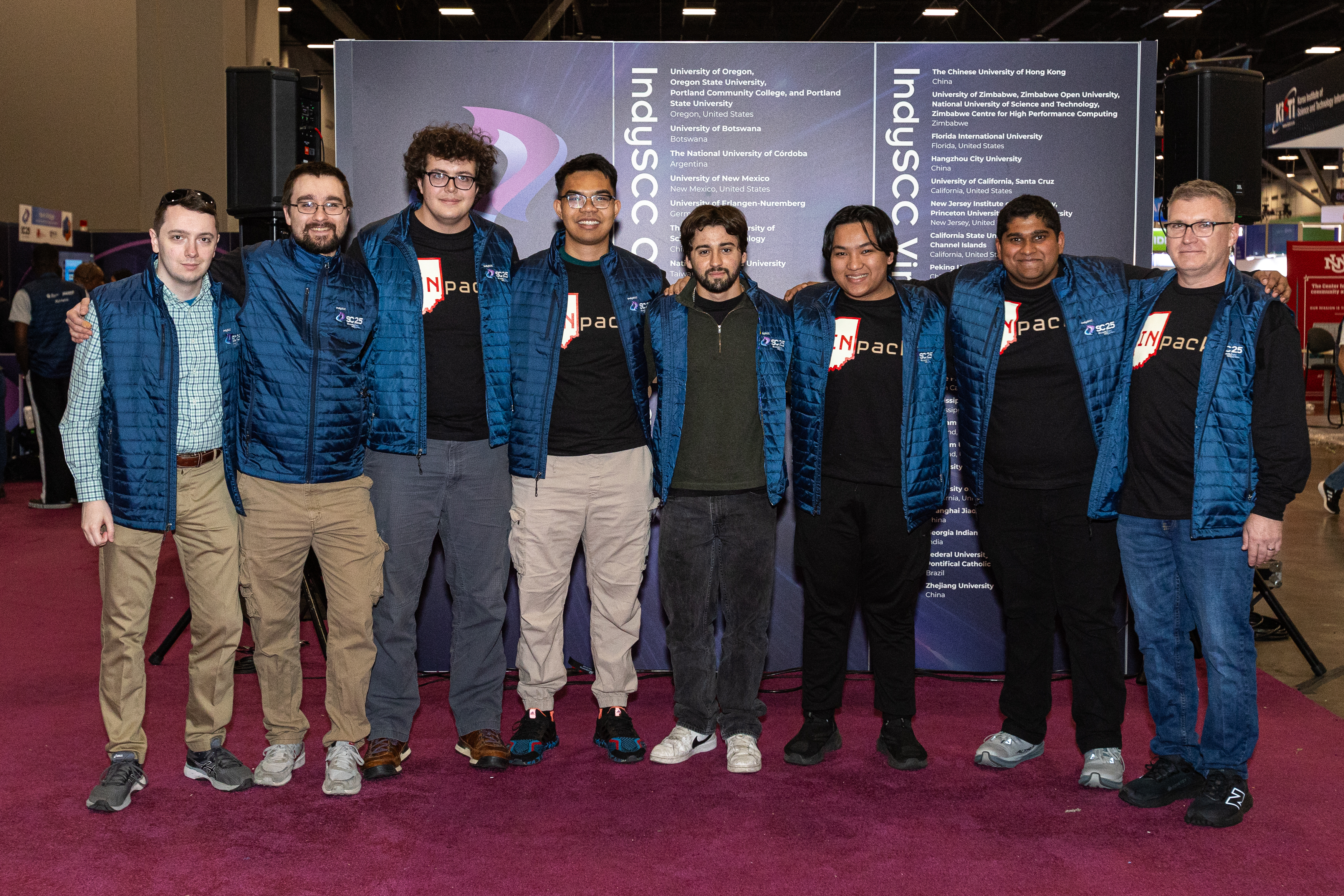 an opportunity for Purdue students to shine. Throughout the week, graduate and undergraduate students from the university were involved in numerous workforce development activities, including giving presentations at the Purdue booth, conducting workshops, and taking part in poster sessions. Two Purdue students competed as part of the INpack team in the 2025 IndySCC, a world-renowned supercomputing competition, while four of the eight Anvil REU students were able to present on the work they conducted during the summer program. Outside of gaining presentation experience, the students were also able to attend different informational sessions and learn about the latest advances in HPC, as well as network and develop connections with people within the community. Providing students with opportunities such as these ties in directly with Purdue’s goal of developing the HPC workforce of the future.
To cap off the fantastic week for Purdue, the new HPL-MXP mixed-precision benchmark list and IO500 lists were released at SC25. Purdue University’s newest supercomputing community cluster, Gautschi, was ranked 27th on the HPL-MXP list and 20th on the IO500 list in the 10 Node Production category. This is an amazing achievement and a testament to the value of Purdue’s continued investment in HPC.
Overall, SC25 was a tremendous success for the university. If you or someone in your department would like to be involved with SC26, please contact rcac-help@purdue.edu.
For more information regarding HPC and how it can help you, please visit our “Why HPC?” page.
Anvil is one of Purdue University’s most powerful supercomputers, providing researchers from diverse backgrounds with advanced computing capabilities. Built through a $10 million system acquisition grant from the National Science Foundation (NSF), Anvil supports scientific discovery by providing resources through the NSF’s Advanced Cyberinfrastructure Coordination Ecosystem: Services & Support (ACCESS), a program that serves tens of thousands of researchers across the United States.
Researchers may request access to Anvil via the ACCESS allocations process. More information about Anvil is available on Purdue’s Anvil website. Anyone with questions should contact anvil@purdue.edu. Anvil is funded under NSF award No. 2005632.
RCAC operates all centrally-maintained research computing resources at Purdue University, providing access to leading-edge computational and data storage systems as well as expertise and support to Purdue faculty, staff, and student researchers. To learn more about HPC and how RCAC can help you, please visit: https://www.rcac.purdue.edu/
Written by: Jonathan Poole, poole43@purdue.edu