

RCAC and IPAI faculty seminar series on AI proves successful
The Rosen Center for Advanced Computing (RCAC), in collaboration with Purdue’s Institute for Physical Artificial Intelligence (IPAI), has successfully introduced a new seminar series dedicated to advancing AI at the university. The new series, titled “AI Hubs Faculty Seminar Series: AI Across Purdue,” is open to anyone at Purdue and takes place in the Hall of Data Science and AI.
The “AI Across 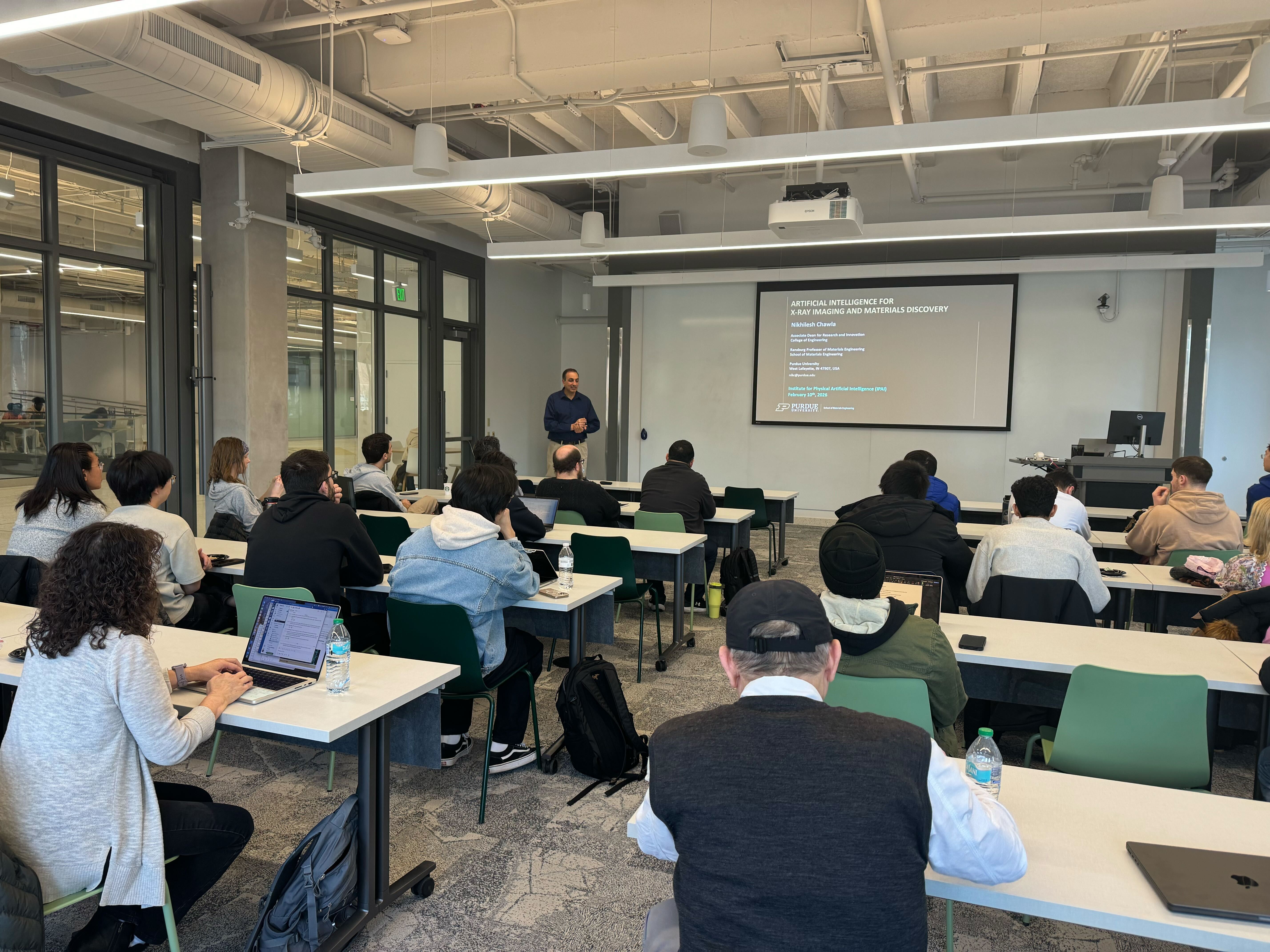 Purdue” seminar series seeks to bring together Purdue faculty and researchers to explore AI opportunities and build connections across campus and NSF-supported programs. Each session features two 20-minute faculty talks on how they are using AI at Purdue, followed by 20 minutes of Q&A and networking. Since the first meeting in early Spring of 2026, the series has connected more than 100 Purdue faculty and researchers, highlighting the importance of dedicated discussions that explore all aspects of AI in research and education.
Unlike traditional training and workshops, this series focuses on advancing knowledge through the sharing of lived experiences and open discussion amongst those at the forefront of AI. Thus far, the talks have covered a wide variety of subjects: materials, mechanical, and nano/quantum engineering, agriculture, biology, and language and culture, as well as some of the AI infrastructure that the researchers used, such as the Gautschi Community Cluster and the Anvil supercomputer. By participating in the “AI Across Purdue” seminar series, attendees not only develop their own AI skillset but also help shape the future of AI at Purdue.
While the “AI Across Purdue” faculty seminar series has been tremendously successful thus far, there’s still time this semester for you to join the conversation. The past and remaining schedule for the series is as follows:
- February 10th: Professor Nikhilesh Chawla (Materials Engineering), Professor Alexandra Boltasseva (Electrical and Computer Engineering)
- March 3rd: Professor Yan Gu (Mechanical Engineering), Professor Jinha Jung (Civil and Construction Engineering)
- March 10th: Professor D. Marshall Porterfield (Agricultural and Biological Engineering), Professor Yaguang Zhang (Agricultural and Biological Engineering)
- March 24th: Professor Vanesa Cañete Jurado (College of Liberal Arts), Professor Maurice Tetne (College of Liberal Arts)
- April 7th: Professor Edwin Garcia (Materials Engineering), Professor Romit Maulik (Mechanical Engineering)
- April 21st: Professor Prianka Baloni (Health Sciences), Professor Mia Liu (Physics and Astronomy)
- April 28th: Professor Mustafa Abdallah (Computer and Information Technology), Professor Rua M. Williams (Applied and Creative Computing)
Each session is attended by RCAC and IPAI organizers in order to answer questions and assist with any AI challenges faced by the attendees. They also acquaint participants with the numerous AI services available through Purdue and the NSF, including the NAIRR Pilot, ACCESS Program, Genesis Mission, Purdue Center for Research Software Engineering, and RCAC AI Support and Expertise.
More information about the “AI Hubs Faculty Seminar Series: AI Across Purdue,” can be found on our Seminar Series Event page.
To stay apprised of upcoming AI-related news and training, please subscribe to our RCAC newsletter and our IPAI newsletter.
RCAC operates the centrally-maintained research computing resources at Purdue University, providing access to leading-edge computational and data storage systems as well as expertise and support to Purdue faculty, staff, and student researchers. To learn more about HPC and how RCAC can help you, please visit https://www.rcac.purdue.edu/ or reach out to https://www.rcac.purdue.edu/rcac-help@purdue.edu to request consultation.
The Institute for Physical Artificial Intelligence (IPAI) is Purdue’s hub for faculty collaboration at the intersection of AI and the physical world. IPAI connects researchers across disciplines to develop secure, robust, and deployable AI systems. Spanning models, hardware, robotics, autonomy, and ethics, IPAI helps apply these capabilities to shared research challenges and emerging opportunities across industry and government domains. To learn more, please visit https://ipai.research.purdue.edu/ or email https://www.rcac.purdue.edu/ipai@purdue.edu.
Anvil is funded under NSF award No. 2005632.
Written by: Jonathan Poole, poole43@purdue.edu