

Envision Center participates in congressional research showcase on Capitol Hill
Earlier this semester, George Takahashi from Purdue’s Envision Center and Danny Milisavljevic from Purdue’s Department of Physics and Astronomy traveled to Washington, D.C. for the Coalition for National Science Funding’s (CNSF) 2026 Research Showcase. While there, the two presented CollabXR—Purdue’s open-source, shared learning platform that puts advanced visualizations at the fingertips of professors and students—to congressional staff. Projects like CollabXR, along with the others highlighted at the event, are excellent examples of why America is at the forefront of science and innovation.
The 2026 Research Showcase 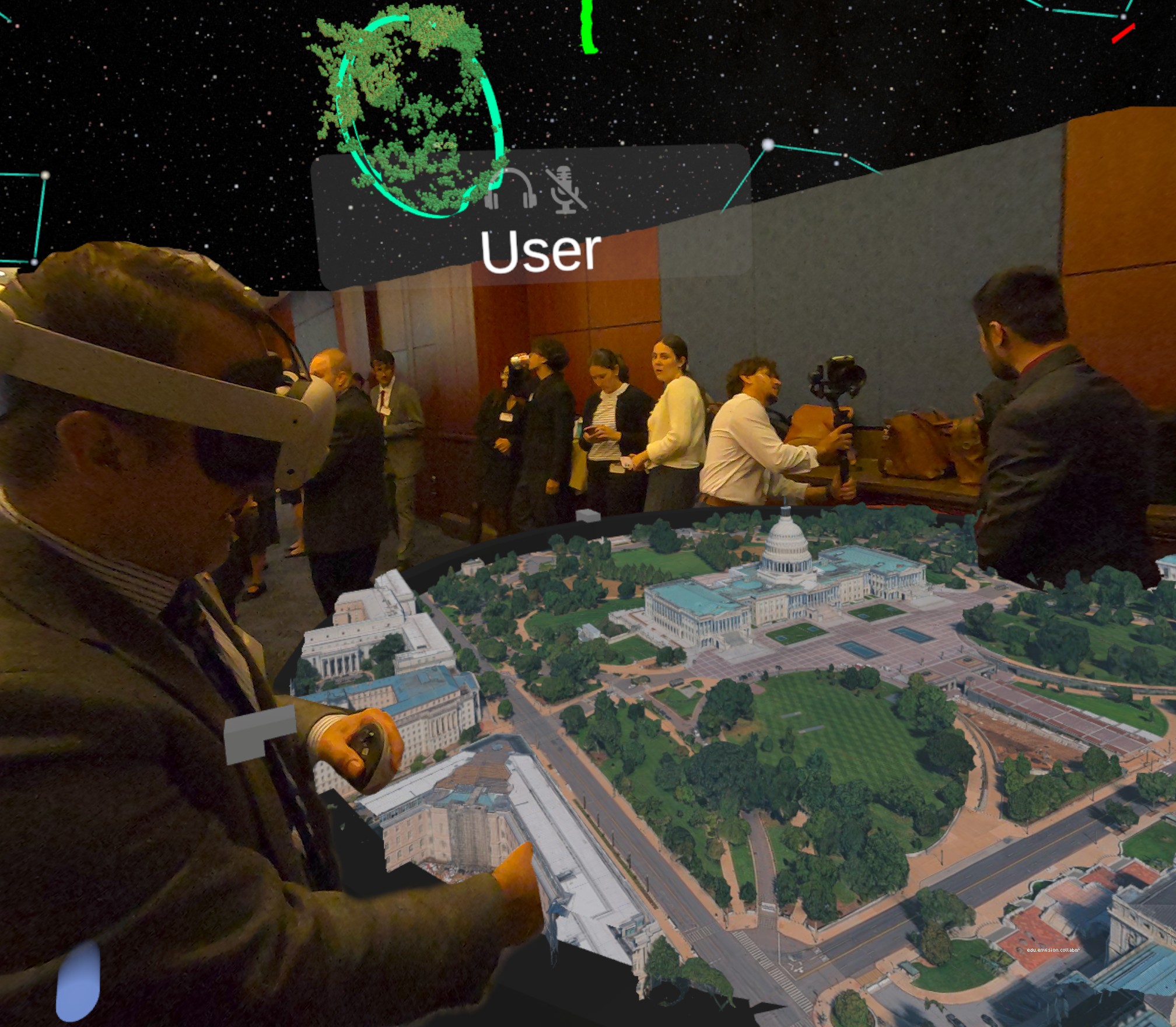 was held on Capitol Hill on September 24. Nearly 200 researchers converged on-site to highlight how investments in the U.S. National Science Foundation drive discovery, strengthen communities, and fuel innovation nationwide. The showcase is designed so that congressional staff can explore interactive, hands-on demonstrations of NSF-funded research spanning scientific disciplines, technology areas, and states. The Purdue group was one of 16 research teams to present their work at the showcase.
“This was a fantastic opportunity to not only showcase our CollabXR platform, but also to highlight the real-world impact of NSF-funded projects directly to Congress,” says Takahashi, Principal Visual Scientist at the Envision Center. “CollabXR has the potential to completely reshape teaching, learning, and research for disciplines that involve complex data visualization. Our goal is to get it in the hands of as many people as possible, so we were thrilled to present it at such a major event in D.C.”
The research showcase lasted approximately two hours, during which Takahashi noted the Purdue booth received a constant stream of people interested in their work. CollabXR (XR=extended reality) is a shared learning platform that leverages cutting-edge AR/VR headsets to let users view and interact with the same virtual content together, immersing them in a learning environment like never before. The Unity-powered platform can ingest almost any 3D dataset, spanning fields from astrophysics to nursing, and even supports geospatial data. By exploring 3D datasets in real-time as a group, CollabXR increases comprehension of complex subjects and improves research and learning collaboration. Milisavljevic led the demonstrations by showcasing his own astrophysics research within the CollabXR platform. He and Takahashi then led participants through multiple datasets and visualizations, including digital twins and geospatial use cases. The pair even pulled up a 3D rendering of Capitol Hill for the congressional staffers to explore. Both Takahashi and Milisavljevic agreed that the trip was a success and felt that the research showcase offered great value to the community.
“Platforms like CollabXR compress the time it takes to understand something complex, because everyone is seeing and discussing the same thing in real time," says Milisavljevic. "Showing that to policymakers was incredibly encouraging. NSF investment in tools like this can help build a workforce that learns faster and collaborates better.”
Takahashi and Milisavljevic would like to extend their thanks to the Coalition for Academic Scientific Computation (CASC) for not only nominating them for attendance at the research showcase, but also for providing travel support.
CollabXR has been an iterative development spanning multiple years, and was recently released as as open source software on GitHub so that researchers nationwide can utilize this amazing technology. To access the source code, please visit: CollabXR GitHub
The Envision Center also created a Discord channel for users to interact with each other and the development team. The channel can be found here: CollabXR Discord
To learn more about CollabXR, including multiple case studies, please visit: CollabXR
The Envision Center is a branch of RCAC dedicated to assisting, supporting, and collaborating with faculty, students, and industry in scientific visualization, virtual and augmented reality, and media creation. The center’s staff and student employees work with faculty partners and external clients to create virtual reality (VR) and data visualization tools for research and educational use. The center also collaborates on grant proposals and develops promotional media, such as publication-quality stills and animated videos. For more information, please visit: Envision Center
Written by: Jonathan Poole, poole43@purdue.edu