Argonne Leadership Computing Facility Lighthouse Initiative
The Rosen Center for Advanced Computing (RCAC) has partnered with the U.S. Department of Energy's Argonne National Laboratory through the ALCF Lighthouse Initiative. This partnership serves to further advance the state-of-the-art high-performance computing (HPC) resources available to Purdue researchers.
What is the ALCF Lighthouse Initiative?

The Argonne Leadership Computing Facility (ALCF) Lighthouse Initiative is a program designed to expand ALCF's user community and propel computational science forward by partnering with academic institutions. Created in 2024, the program's goal is to broaden the reach of HPC and actively engage with the next generation of computing professionals. Purdue University is the fourth institution to join the initiative. By partnering with ALCF and becoming a Lighthouse Institution, Purdue now offers researchers access to the most powerful open science resources in the country.
How will Purdue researchers benefit?
As an ALCF partner and Lighthouse Institution, Purdue researchers have additional computational tools to conduct innovative science at scale, enabling Purdue to advance discovery and achieve significant breakthroughs previously unimaginable. Purdue will be given a discretionary allocation for ALCF machines, and the RCAC staff will receive intensive training on the use of these systems. RCAC will then be able to provide support for Purdue faculty and researchers looking to scale their science to leadership-class systems. This includes:
- Preparing, porting, and testing applications for suitability of ALCF resources
- Scaling applications for use on ALCF systems
- Aiding in migrating projects from Lighthouse to an ALCF larger allocation, such as INCITE/ALCC/Director's Discretionary for graduating projects
- Offering access to specialized training tailored for the Purdue researchers offered by ALCF
- Providing information about summer internship opportunities for students
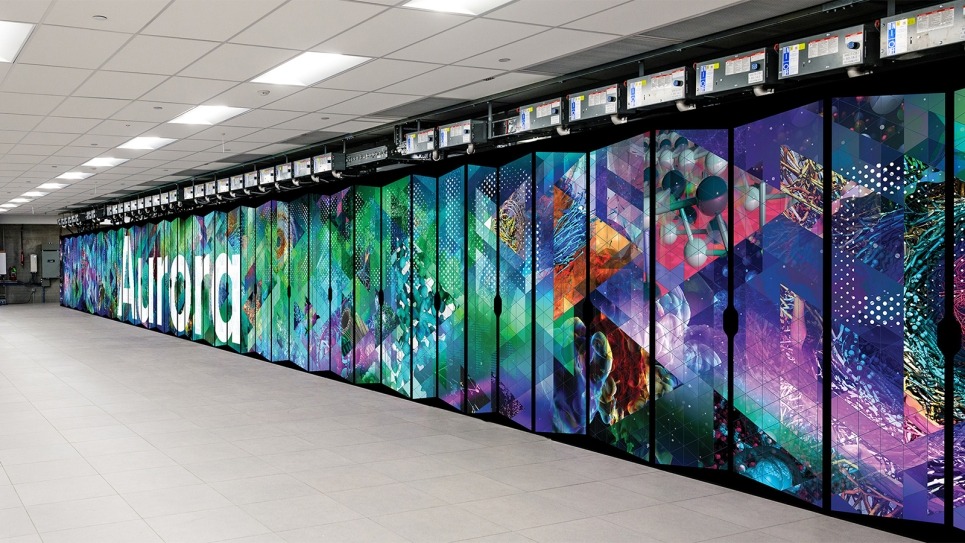
RCAC will identify and onboard users whose research projects could best utilize the advanced HPC resources provided by ALCF. These users will then be granted access to GPU-accelerated nodes on both the Polaris and Aurora supercomputers. Aurora is one of the world's most powerful supercomputers. As an exascale system, it is able to perform over a quintillion calculations per second.
Excellence at Scale
With this newfound partnership, Purdue has reached the pinnacle of delivering excellence at scale for computational researchers. RCAC can now provide access to the full spectrum of computing performance possible with today's technology. No matter your job size or computational needs, RCAC has the appropriate resource for you.
"We're excited to add the ALCF Lighthouse to the portfolio of resources available to Purdue researchers to solve their scientific problems using both physics-based simulation and AI," says Preston Smith, Executive Director of RCAC and Director of Computing Infrastructure for Purdue's Institute for Physical Artificial Intelligence. "Between our powerful campus resources, the National Science Foundation's ACCESS program where we operate Anvil, and now the ALCF Lighthouse partnership, there's a clear path for researchers to scale up to the most powerful machines in the nation. Our team is ready to assist researchers who are ready to scale up, all the way from their laptop to Aurora."
By providing the university with an avenue for access and support on these leadership-class systems, RCAC is helping Purdue in its persistent pursuit of innovation, driving the university to the forefront of science and technology.
ALCF Resources:
- Aurora: Argonne's exascale supercomputer which contains a whopping 10,624 nodes. The machine is equipped with 63,744 GPUs and 8 fabric endpoints per node (84,992 total!). The system is built on the HPE Cray EX supercomputer platform and includes Slingshot 11 interconnect as the network backbone. Please visit the Aurora website to learn more about the system.
- Polaris: Polaris is a leading-edge supercomputer initially designed as a testbed for researchers and developers to optimize their codes for use on Aurora. Alongside its role as a testbed, Polaris now fully supports scientific research in its own right. Polaris contains 560 nodes and is built on the HPE Apollo 6500 Gen 10+ platform. Each node has a single 2.8 GHz AMD EPYC Milan 7543P 32-core CPU, complemented by 512 GB of DDR4 RAM, as well as four NVIDIA A100 GPUs. To learn more about the system, please visit the Polaris website.
Call for Proposals
Purdue faculty and researchers wanting to take advantage of ALCF resources must have a minimum job size of 10 nodes (40 GPUs). To apply for resource allocation, please contact RCAC.
To learn more about the ALCF Lighthouse Initiative, please visit the ALCF Lighthouse Initiative website.