

Gautschi Community Cluster ranks high in international benchmark competitions
Gautschi, Purdue University’s most powerful supercomputer, was recently ranked among the top high-performance computing (HPC) systems on two separate, international benchmarks. The community cluster ranked 20th on the IO500 benchmark in the “10 Node Production” category and 27th on the HPL-MxP benchmark. Both lists were released at this year’s international supercomputing conference, SC25.
In late 2024, 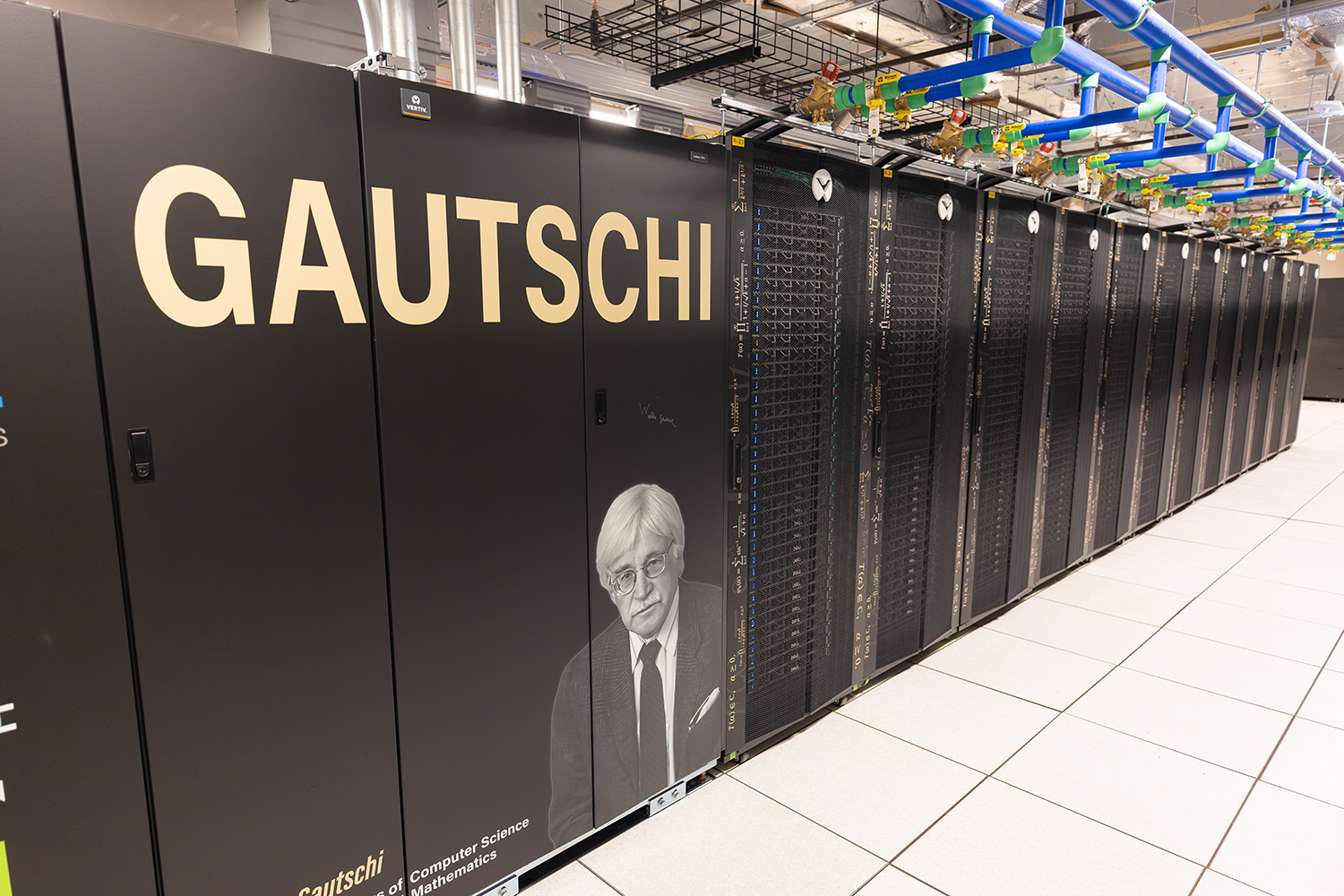 Purdue unveiled its newest and most powerful supercomputer to date, Gautschi. The Gautschi cluster was designed to provide Purdue researchers with a world-class computing resource capable of driving the university toward its next giant leap. Eponymously named in honor of Walter Gautschi, Professor Emeritus of Computer Science and Professor Emeritus of Mathematics at Purdue University, the Gautschi supercomputer consists of two partitions—a traditional HPC resource focused on providing next-generation CPUs and a dedicated AI partition containing Nvidia H100 SXM GPUs.
Each year, supercomputers may be entered into benchmark competitions to test different aspects of their performance. For example, when Gautschi debuted in the Fall of 2024, it ranked number 157 on the Top500 list of the world’s most powerful supercomputers and number 43 on the Green500 list of the most energy-efficient supercomputers. This year, staff at the Rosen Center for Advanced Computing (RCAC) decided to measure Gautschi’s performance on the IO500 and HPL-MxP benchmarks.
The IO500 benchmark has become the standard for measuring HPC storage performance. It consists of five separate workloads to identify performance boundaries for HPC applications. On this year’s list, Gautschi was ranked 20th in the “10 Node Production” category, with a peak read performance of 186.54 GB/second. Only three other US university machines bested it on the benchmark. Gautschi also ranked 194th overall on the full list of IO500 submissions. Gautschi’s storage system is built with DDN’s Exascalar filesystem.
The HPL-MxP mixed-precision benchmark is tailored for testing a machine’s ability to handle artificial intelligence (AI) workloads. It combines testing parameters from the traditional HPL framework, one of the most popular benchmarks in the world, with AI-specific constraints. The HPL-MxP results are released biannually. Gautschi was ranked 27th overall on the November 2025 list, and was the top US university machine listed.
“We are excited to see how Gautschi stacks up against the world’s most powerful systems”, says Preston Smith, Executive Director of the Rosen Center for Advanced Computing in Purdue IT. “I/O performance is critical for AI computing to keep GPUs fed with data, and this benchmark score directly reflects the benefits Purdue researchers will get from using Gautschi. Using mixed-precision arithmetic allows HPC applications to leverage AI-optimized accelerators like GPUs, which use lower precision. Mixed-precision computing uses less power and allows for significant speed-ups, reducing time to science. Gautschi’s HPL-MxP score shows a more than 4x speedup on the same hardware simply by using lower precision arithmetic.”
The Gautschi cluster was built through a partnership with Dell, AMD, DDN, and Nvidia, thanks to support from Purdue Computes and the Institute for Physical AI (IPAI). Purdue researchers may obtain access to the Gautschi system through RCAC’s Community Cluster Program. For more information or to purchase access to Gautschi, please visit our Purchase Page.
RCAC operates the centrally-maintained research computing resources at Purdue University, providing access to leading-edge computational and data storage systems as well as expertise and support to Purdue faculty, staff, and student researchers. To learn more about HPC and how RCAC can help you, please visit: https://www.rcac.purdue.edu/
Written by: Jonathan Poole, poole43@purdue.edu