

Purdue researcher collaborates with Envision Center on INDOT driving simulator
A Purdue University researcher recently partnered with the Rosen Center for Advanced Computing’s (RCAC) Envision Center to develop a driving simulation platform for the Indiana Department of Transportation (INDOT). This platform allows users to test-run driving through novel intersection designs in a risk-free setting.
Dr. Ziran Wang is an Assistant Professor of the Lyle School of Civil and Construction Engineering and leads the Purdue Digital Twin Lab. He recently worked with the Envision Center, a group within RCAC’s Research Software Engineering (RSE) Center, on an INDOT project aimed at improving driver understanding and acceptance at innovative intersection designs within the state of Indiana.
Intersections can  be challenging for drivers. Traditional signalized and two way stop control intersections present right angle conflicts that sometimes result in poor safety performance. According to the U.S. Federal Highway Administration, roughly one-quarter of traffic fatalities and one-half of traffic injuries occur at intersections. Of course, intersecting roadways are unavoidable and quite necessary. So to reduce the risk of intersection accidents, a nationwide push for new, thoughtful intersection designs has led to the development of “innovative intersections.” Innovative intersections are designed to enhance safety and improve traffic flow by reducing or modifying conflict points—locations where the paths of two or more road users intersect—within an intersection. There are numerous types of innovative intersections that have proven to reduce accidents and fatalities, yet very few of these novel designs have been integrated into our roadways. The problem is inherent to the solution itself: new designs are unfamiliar to drivers, leading to unease, confusion, and public resistance. To help ease this general discountenance of innovative intersections, Wang wanted to develop a driving simulator for INDOT that would allow the general population, as well as key policymakers, to experience proposed intersection designs in a risk-free setting.
“Innovative intersections are a proven solution,” says Wang, “but getting the public at large to accept them as well as learn to use them appropriately is a challenge. Our goal is to meet this challenge by giving people a chance to experience these intersections without having to be driving at speed on the roadway.”
Wang reached out to the Envision Center for help with this project. Together, the team developed the “Portable Driving Simulation Platform.” This platform is a Unity game engine-based simulator that provides an immersive, interactive environment for users to try out new intersection designs without ever having to set foot inside a vehicle.
The Portable 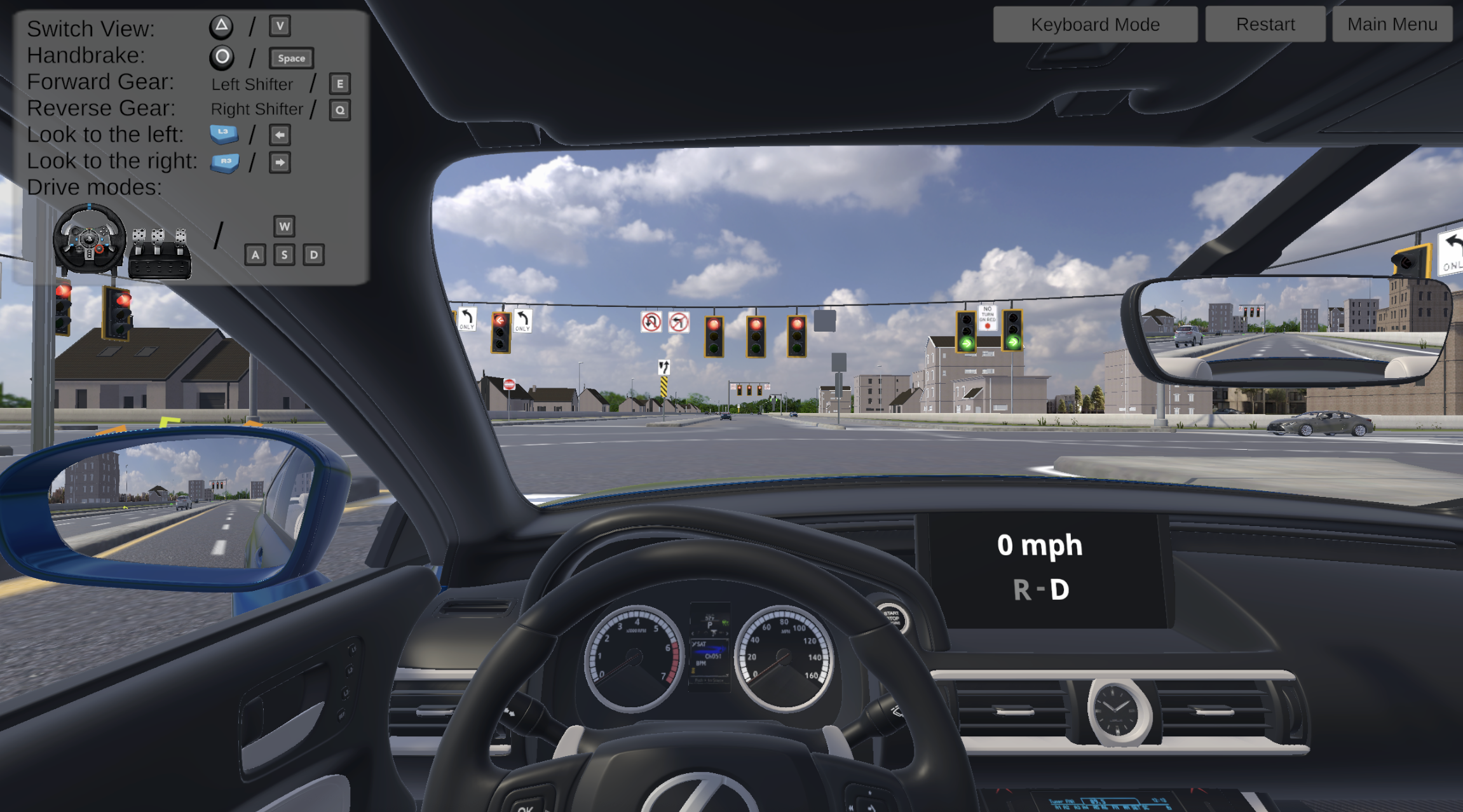 Driving Simulator Platform involves five kinds of innovative intersections: a displaced left turn (DLT), a reduced-conflict intersection (RCI), a diverging diamond interchange (DDI), two-lane roundabouts (RAB), and roundabout interchanges (RBI). Three-dimensional maps of these five intersection types were developed by the team, as well as multiple car models and both first-person and third-person viewpoints for users to experience. The group also implemented traffic signals and collision avoidance algorithms into the simulator.
“This was a fun, collaborative 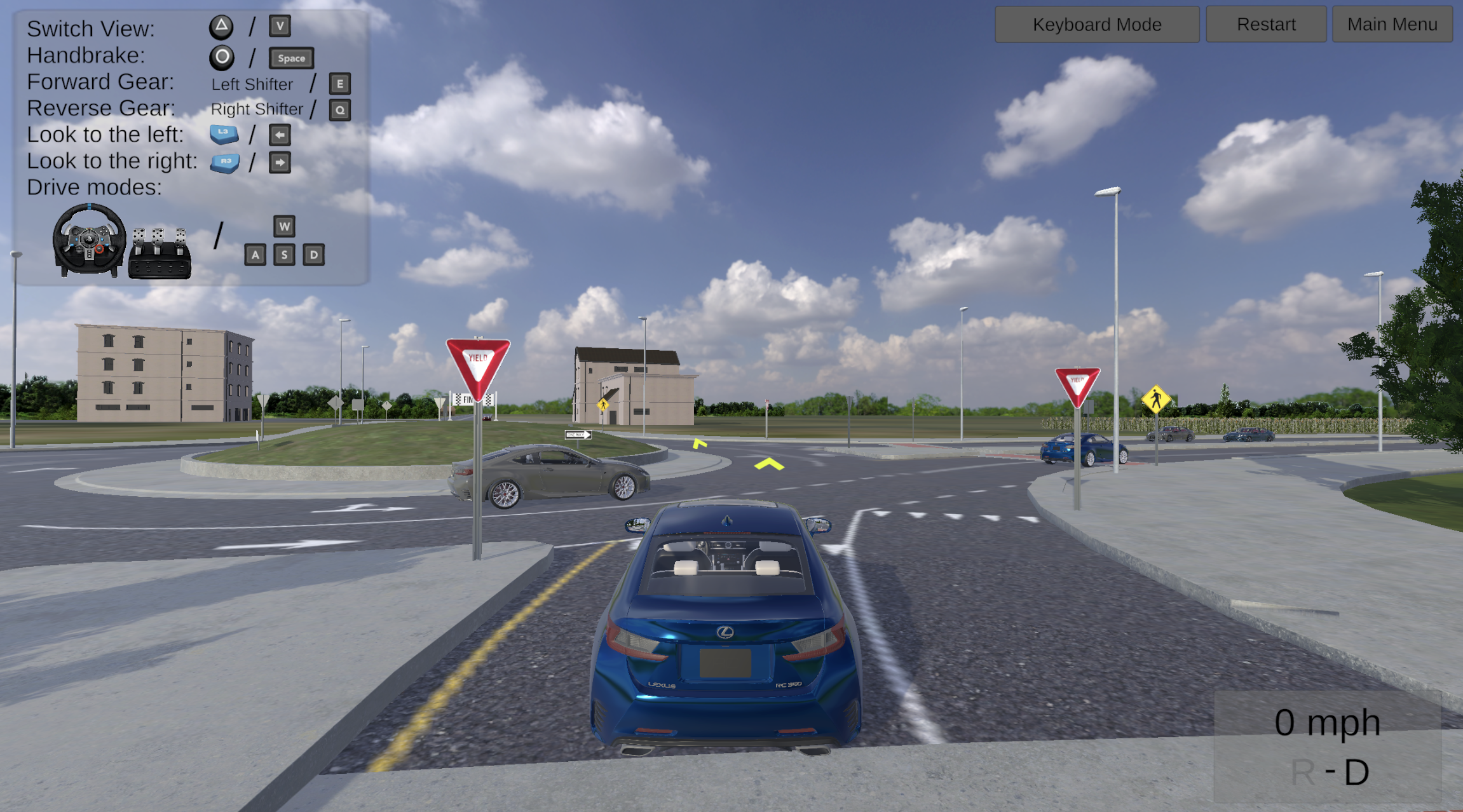 project,” says George Takahashi, Principal Visualization Scientist at the Envision Center. “We [the Envision Center] focused our efforts on developing the environment and 3D work design, while Dr. Wang and his graduate student, Luyang Jiang, worked on the driving mechanics, vehicle behavior, and simulation programming. Thanks to this shared development, we now have a solid foundation to build upon new driving scenarios and explore more collaboration opportunities in the future.”
Now that the first iteration of the Portable Driving Simulation Platform has proven successful, the group intends to further enhance the simulator for INDOT. Future work plans include integrating steering wheel and paddle user controls and overall optimization and beautification, to make it feel as realistic as possible. Eventually, Wang would like to see this platform used across Indiana with widespread deployment at BMV branches, and as a fundamental testing platform for traffic analysis.
“This collaboration with the Envision Center has totally revolutionized the way we conduct digital twin research. We used to spend much time identifying appropriate off-the-shelf platforms for conducting simulation studies on intelligent transportation systems, and now we can build our own easily with a proven pipeline. ”
To learn more about Dr. Wang’s research, please visit his website: https://ziranw.github.io/
The Purdue Center for Research Software Engineering (the RSE center) is a university-approved center within the Rosen Center for Advanced Computing. Its official establishment recognizes the increasingly vital role that software plays in all fields of scientific research, and formalizes RCAC’s software engineering efforts at RCAC to better support research at Purdue. The RSE center’s mission is to help accelerate research and increase its impact through the creation of innovative, robust, and sustainable research software.
The Envision Center is a team within the RSE Center dedicated to assisting, supporting, and collaborating with faculty, students, and industry in scientific visualization, virtual and augmented reality, and media creation. The center’s staff and student employees work with faculty partners and external clients to create virtual reality (VR) and data visualization tools for research and educational use. The center also collaborates on grant proposals and develops promotional media, such as publication-quality stills and animated videos. For more information on the Envision Center, please visit their Main Page. To see other projects the Envision Center has taken on, you can visit their Project Showcase.
Written by: Jonathan Poole, poole43@purdue.edu