

CI-XP student gains real-world HPC experience while boosting RCAC systems
The Rosen Center for Advanced Computing’s (RCAC) core mission is to provide researchers access to leading-edge computational and data storage systems as well as expertise in a broad range of high-performance computing (HPC) activities. As a major center operating at Purdue University, RCAC’s secondary goal is to enhance student and educational outcomes in a variety of ways, including through hands-on workforce development. The center’s CI-XP (Cyber Infrastructure - eXPerience) Program is designed as the workforce development pipeline for HPC at Purdue. Recently, a Master’s student leveraged this pipeline to not only increase his knowledge while gaining real-world experience, but also directly impact major projects at RCAC, all of which will help him take his next giant leap.
Shubham Jha  is a second-year Master's student in Engineering Management at Purdue University. He came to Purdue in August of 2024 after working as a full stack developer for Cisco. After settling in at the university, Jha decided to apply for a job at RCAC through the CI-XP program. Jha was initially hired in May of 2025 onto the Research Software Engineering (RSE) team as a front-end developer for RCAC’s proprietary unified HPC center operations portal, Halcyon. Since then, Jha has grown far beyond that original role: leading application development for the U.S. Air Force, architecting agentic AI solutions for cross-institutional collaborations, and designing the disaster-recovery strategy for a $4 million NSF project — the list is extensive. Again and again and again, Jha has proven himself an invaluable asset to RCAC’s team, but his experience with the CI-XP program is not a happy accident, it’s a design feature.
CI-XP prides itself on the fact that the program does not partake in “toy” projects. Students gain real workplace experience by taking on tasks with real-world impact. Interest in different pathways and fields is often rewarded; in Jha’s case, he began as a front-end website developer, found an interest in other areas, and was encouraged to pursue those interests:
“My experience with RCAC and the CI-XP program has been wonderful,” says Jha. “Learning-wise, when I was at Cisco, we would get a single project and our deliverables focused only on that. So when I was a network engineer, I only used to write Python scripts, or I only used to fix bugs. When I transitioned to the front-end engineering team, I only used to do front-end development. But at RCAC, in the span of one year, I have been able to touch different types of projects, initially starting as a front-end developer, then moving on to the back-end and eventually agentic AI. RCAC gives me the time and opportunity to ramp up, so I am able to learn about things from different researchers and I'm also able to apply those learnings practically.”
Jha continues, “Getting to work on different technologies, different aspects of what’s relevant in the industry, that’s what I enjoy most about RCAC. Whenever I want to grow or expand my knowledge base or my technical expertise, I just ask Daniel [Madren, Lead Research Development Administrator] and he finds a way to get me onto those projects. I can learn about different domains and actually work on them. It's one of the best things — I'm not restricted to a specific task for a specific responsibility, and I can explore different projects.”
Jha’s experience is not unique for the CI-XP program, but he more than earned the trust required from leads to put a student on such important projects.
"Shubham has a rare combination of technical ability, sound judgment, initiative, and interpersonal skill,” says Daniel Madren, Program Manager for the Research Software Engineering Center at RCAC and a CI-XP mentor. “He has earned the trust of our team by communicating clearly, collaborating across functions, and taking ownership of complex work without needing to be closely directed. He does not simply complete assigned tasks, he identifies what needs to be done and helps move the work forward. Over the past year, he has become a valued colleague and a true team player. I have learned as much from Shubham as he has learned through the CI-XP program, and working with him has been a genuine pleasure."
In his time thus far at RCAC, Jha has worked on nine distinct projects, contributing in multiple ways to each one. One notable contribution is Jha’s work on the StreamCI project. StreamCI is a real-time sensor data management and processing infrastructure hosted entirely on Purdue’s Anvil supercomputer. Funded by a $4 million grant via the NSF CSSI program, StreamCI is designed as an artificial intelligence (AI)-ready streaming data platform used to support diverse scientific applications. Jha’s role on the team was varied. He began by developing the initial landing page for the StreamCI website. Then, Jha helped transition the platform from an older streaming backbone to a newer one preferred by the team. Specifically, he engineered the migration from RabbitMQ to a production 3-node Apache Kafka cluster with replicated, partitioned topics and 30-day retention, enabling new processing stages to be added without modifying existing ingestion paths. After the Kafka migration, Jha set his sights on StreamCI’s data backup strategy.
Being able to perform disaster recovery is of the utmost importance for research teams who rely on massive volumes of data for their work. To ensure StreamCI had this capability, Jha built an end-to-end S3 backup infrastructure — from the initial S3 backup foundation to a unified Kustomize base — plus development/production overlays with standalone CronJobs, dual-endpoint S3 support (separate source/destination), and a restore-benchmark harness. He also added point-in-time recovery with a 6-hourly oplog incremental CronJob for production, a shared PITR marker across full/incremental jobs, and extended oplog retention so restores can roll forward between full backups. Simply put, Jha solved the data backup issue.
“What stood out about Shubham was the ownership he took — he didn't just close out tasks, he looked at where StreamCI was heading and solved the hard problems before they became blockers,” says Jaewoo Shin, a Research Scientist at RCAC and the technical lead for StreamCI. “The Kafka migration and the backup and disaster-recovery infrastructure he built are still load-bearing parts of the platform today, and he designed them so cleanly that our team could keep extending the system without ever having to untangle his work. As the dev lead, that's the highest compliment I can give an engineer — I could hand him a critical piece of the platform and never worry about it again.”
Another notable project that Jha worked on was the ACID-R (Automated Commercial Industry Data – Repository) platform. ACID-R is designed to help the U.S. Air Force identify promising new technologies with more efficiency by harnessing the power of AI, but with no risk of hallucination (AI-fabricated false information). The platform connects commercial vendors with the Air Force — vendors can upload their capability statements, and the Air Force can view, search, and filter through them all (thousands of proposals) with the help of AI. Jha assisted with this project by tackling:
- Front-end Dashboard development and design
- Back-end development with APIs (Application Programming Interface)
- Integration of the platform with RAGs (Retrieval-Augmented Generation)
- Deployment to Geddes (RCAC’s Community Composable Platform) and Rowdy (RCAC’s technology testbed)
ACID-R also happens to be Jha’s favorite project so far:
“I really enjoyed working on the Air Force project because at Cisco, I only worked as a front-end developer, in which I was given a Figma file by my team, and I just created a website based on the Figma file,” says Jha. “But on this project, we actually didn't have the design. We had to come up with one that would solve their problem. So we had to work with AI researchers like Elham [Barezi, Lead AI Research Scientist at RCAC] to actually achieve the functionality that would satisfy the customers. I learned about RAG pipelines and was able to deploy the application on Rowdy as well. Before this, I had no experience working on deployment. I would only run applications on my system and then give it to the DevOps team, and they would deploy it on other systems. Getting to do everything from the requirements gathering, coordinating with the customers and AI researchers, deploying it myself and optimizing it, and getting to learn while I was doing this project was a great experience for me, and that's why it's my favorite project so far at RCAC.”
The amount of work the Jha has accomplished throughout his time at RCAC is astonishing, especially considering that he is concurrently pursuing his Master’s. Thankfully, the CI-XP program understands that a student’s education comes first and allows for a lot of flexibility with work hours.
“Because Daniel is quite flexible, I am able to balance my work at RCAC based on my hours,” says Jha. “I can do the work whenever I have free time, instead of on a set schedule. That’s how I have been able to manage projects while still following my day-to-day Master’s schedule.”
The CI-XP 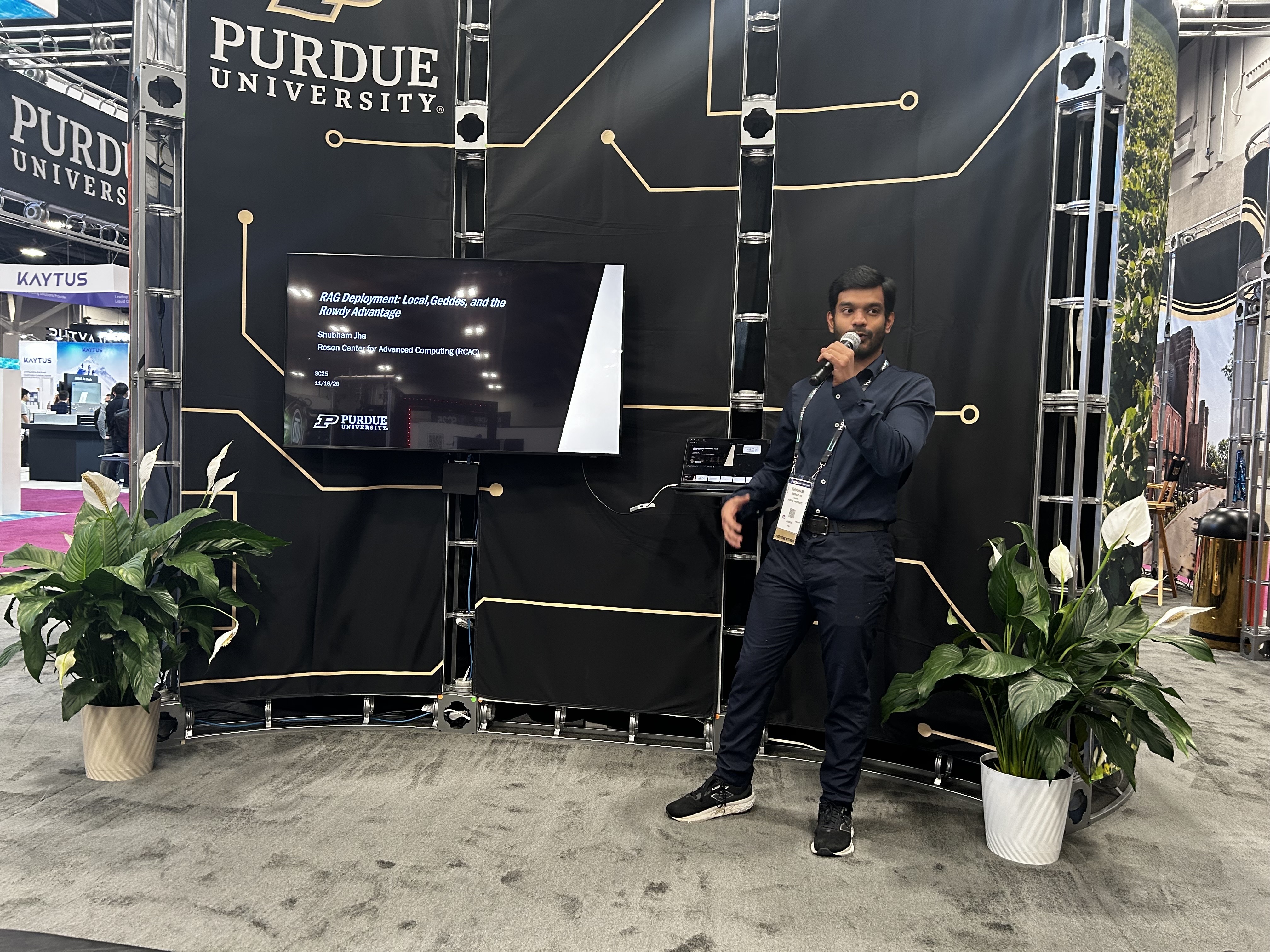 program also encourages students to attend conferences in their field and even helps support them financially through travel scholarships. Because of his association with the program, Jha has been able to attend numerous conferences while at RCAC, including: SC25, PEARC25, Nvidia GTC 2026, DesignCon 2026, and Developer Week 2026. Thus far, he has liked SuperComputing (SC) the most, which is unsurprising given that it is the largest international conference for HPC.
“Supercomputing was my favorite one so far because it's the biggest conference I have ever attended, and seeing so many solutions on the floor, getting to interact with professionals involved in HPC — it was great,” says Jha. “I met product managers from Microsoft and HP. I got the opportunity to learn about quantum AI and saw how I can use different technologies in my own personal work. For instance, I took a workshop on Agentic AI which really helped me to upskill myself and understand what the Telecoupling Toolbox project [a Michigan State University collaboration Jha is currently working on] actually requires, and come up with the architecture for it.”
In his time at RCAC, Jha has made a huge impact on the organization and the various projects he has been a part of, not only writing software, but shaping what gets built and why. Even more importantly, he has enjoyed the CI-XP program and benefited tremendously from it, which is why he highly recommends it to other students at Purdue:
“My experience with RCAC has been wonderful,” says Jha. “I’ve gotten to learn a lot, network with a lot of people, and attend some great conferences. I would definitely recommend looking for opportunities with the CI-XP program. You get to learn from the researchers at RCAC, and all of them are so helpful. Whenever I have issues or need some clarification, I can just reach out and all of them are ready to help me. The team is also really understanding regarding your other commitments, and makes accommodations for you. The program helps you in the long run as well by building up your profile and resume. It’s great.”
To learn more about CI-XP opportunities, please visit: CI-XP Student Program
The Purdue Center for Research Software Engineering (aka the RSE center) is a university-approved center within RCAC. Its official establishment recognizes the increasingly vital role that software plays in all fields of scientific research, and formalizes RCAC’s software engineering efforts at RCAC to better support research at Purdue. The RSE center’s mission is to help accelerate research and increase its impact through the creation of innovative, robust, and sustainable research software. To learn more about the center and how we can help you, please visit: Purdue RSE Center
To learn more about High-Performance Computing and how it can help you, please visit our “Why HPC?” page.
Anvil is one of Purdue University’s most powerful supercomputers, providing researchers from diverse backgrounds with advanced computing capabilities. Built through a $10 million system acquisition grant from the National Science Foundation (NSF), Anvil supports scientific discovery by providing resources through the NSF’s Advanced Cyberinfrastructure Coordination Ecosystem: Services & Support (ACCESS), a program that serves tens of thousands of researchers across the United States. Anvil also supports advanced artificial intelligence research as an official resource provider of the National Artificial Intelligence Research Resource (NAIRR) Pilot.
Researchers may request access to Anvil via the ACCESS allocations process or through the NAIRR allocations process. More information about Anvil is available on Purdue’s Anvil website. Anyone with questions should contact anvil@purdue.edu. Anvil is funded under NSF award No. 2005632.
Written by: Jonathan Poole, poole43@purdue.edu