

Purdue makes an impact at supercomputing conference, SC26
Purdue University proved to be a major presence at this year’s International Conference for High Performance Computing, Networking, Storage and Analysis (SC26). From fascinating presentations at the Purdue exhibitor’s booth to innovative research posters and papers, Purdue’s participation highlighted why the university is a national leader in HPC and research in higher education.
SC26 is an annual conference where higher education, government, and industry gather in one location for a week of communication, collaboration, and innovation. This year’s iteration took place in Chicago, Illinois, from November 15-20. A record-breaking 24,000+ attendees flocked to the conference to learn about the latest advancements in HPC, quantum computing, and artificial intelligence (AI) technologies. Purdue’s exhibitor booth, hosted by the Rosen Center for Advanced Computing (RCAC), was a big hit amongst attendees this year, seeing a constant stream of people who wished to speak with our HPC experts or connect with their alma mater.
Purdue’s central 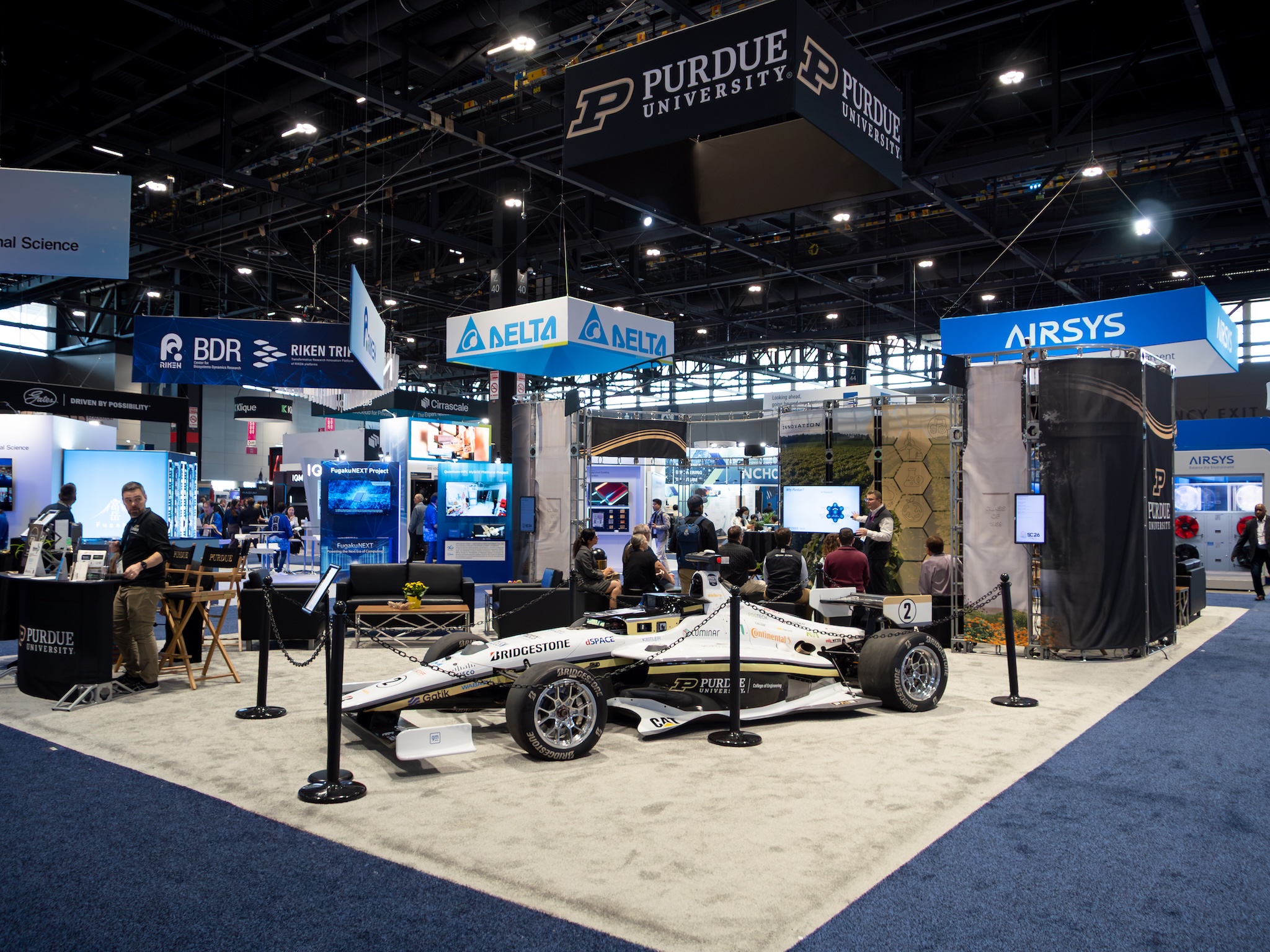 theme for SC26 was to promote the Purdue Computes initiative. To drive home the real-world impact of the initiative, Purdue’s showstopping centerpiece at the booth was the Purdue AI Racing team’s autonomous racecar. The car is fully automated, using AI algorithms and specialized sensors to navigate the world. Purdue students develop and fine-tune the software, as well as provide on-site management for international autonomous races. Without a doubt, having the car at the booth was a boon for Purdue, drawing even larger crowds than usual for the conference.
Beyond the automated racecar, the Purdue booth had plenty to offer to attendees. Booth presentations were given throughout the week, led by experts from multiple Purdue departments. The Purdue for Life Foundation also helped host, connecting with alumni and offering give-aways for Purdue-themed swag. On family night, the Envision Center showcased CollabXR, allowing participants to gain hands-on experience with Purdue’s extended-reality (XR) shared learning platform. Outside of the booth exhibits, Purdue staff participated in numerous workshops, Birds-of-a-feather sessions (BOFs), and panel discussions highlighting the university’s contributions to research computing and HPC in higher education. A complete list of SC26 papers and presentations given by Purdue affiliates is as follows:
- Carol Song: Building the Scientific Data Fabric Community for AI-Driven Discovery
- Nick Eliopoulos: Domain-Aware Power Rebalancing under Node-Level Power Caps on Aurora
- Teresa Boland: HARD: Leveraging FleCSI for Heterogeneous Multi-Material Hydrodynamics
- Vasileios Georgiou and Petros Drineas: Numerical Linear Algebra in the Age of Coding Agents
- Branden Turner, Guangzhen Jin, and Bithi De: Pelicanvil: A Web Platform for Discovering, Browsing, and Accessing Federated Datasets on HPC
- Charles Bouman: Scale to See: Scalable AI for Scientific Imaging and Spatiotemporal Data
- Erik Gough and LJ Lumas: Secure integration and scaling for thousands of Jupyter sessions across hybrid cloud and HPC resources on Anvil
- Preston Smith and Ryan DeRue: Skip the SuperPOD - The User-Driven Case for Throughput-Optimized GPU Clusters
- Geoffrey Lentner: uv-manager: A Transparent Wrapper for Safe, Architecture-Aware Python Environments on Heterogeneous HPC Clusters
- Geoffrey Lentner: AI Agents on HPC and Reproducible Research
- Geoffrey Lentner: Agents at the Gate: High-Throughput Computing in the Agentic Era
For more information on each listing, please visit: Purdue Presentations at SC26
SC26’s success as a whole this year is due in part to Purdue contributions. Staff and affiliates from the university volunteered to support multiple committees, organizations, and events at the conference, including the SC26 Planning Committee (the organizing body for SC26), SCinet (the collaborative group that builds the infrastructure and network for the conference), and the Student Cluster Competition (a 48-hour HPC competition). Thanks to these volunteers, Purdue lent its expertise towards building and running the entire conference.
For Purdue students, the conference was an excellent venue for gaining experience and exposure in the field of HPC. Throughout the week, graduate and undergraduate students from the university were involved in numerous workforce development activities, including giving presentations at the Purdue booth, conducting workshops, and taking part in poster sessions. The students were also able to expand their knowledge by attending various informational sessions and learning about the latest advances in HPC. As with all major conferences, networking opportunities were abundant, enabling the students to develop connections with people within the community. All of this directly corresponds with the Purdue Computes initiative and its goal of developing the computing workforce of the future.
While at SC26, Purdue was listed as a partner on the HPCwire Reader’s Choice Award for “Best HPC/AI Collaboration.” The award was given to the NSF ACCESS program and its fourteen integrated resource providers for “providing the nation’s research and education community with the computational capacity and support services needed to advance the state of the art in AI and all fields of study by bringing together government, academia, and technology partners.” Purdue supports the ACCESS ecosystem via its Anvil supercomputer. Anvil is one of the university’s most powerful supercomputers, providing researchers from diverse backgrounds with advanced computing capabilities. The system boasts over 1,000 compute nodes, as well as an AI partition containing 84 NVIDIA H100 GPUs. This state-of-the-art computing system has supported research projects throughout the nation that span dozens of scientific fields, including the 2026 Nobel Prize in Physics.
SC26 was a great success for Purdue. If you or someone in your department would like to be involved with SC26, please contact rcac-help@purdue.edu.
To learn more about High-Performance Computing and how it can help you, please visit our “Why HPC?” page.
Anvil is one of Purdue University’s most powerful supercomputers, providing researchers from diverse backgrounds with advanced computing capabilities. Built through a $10 million system acquisition grant from the National Science Foundation (NSF), Anvil supports scientific discovery by providing resources through the NSF’s Advanced Cyberinfrastructure Coordination Ecosystem: Services & Support (ACCESS), a program that serves tens of thousands of researchers across the United States. Anvil also supports advanced artificial intelligence research as an official resource provider of the National Artificial Intelligence Research Resource (NAIRR) Pilot.
Researchers may request access to Anvil via the ACCESS allocations process or through the NAIRR allocations process. More information about Anvil is available on Purdue’s Anvil website. Anyone with questions should contact anvil@purdue.edu. Anvil is funded under NSF award No. 2005632.
Written by: Jonathan Poole, poole43@purdue.edu